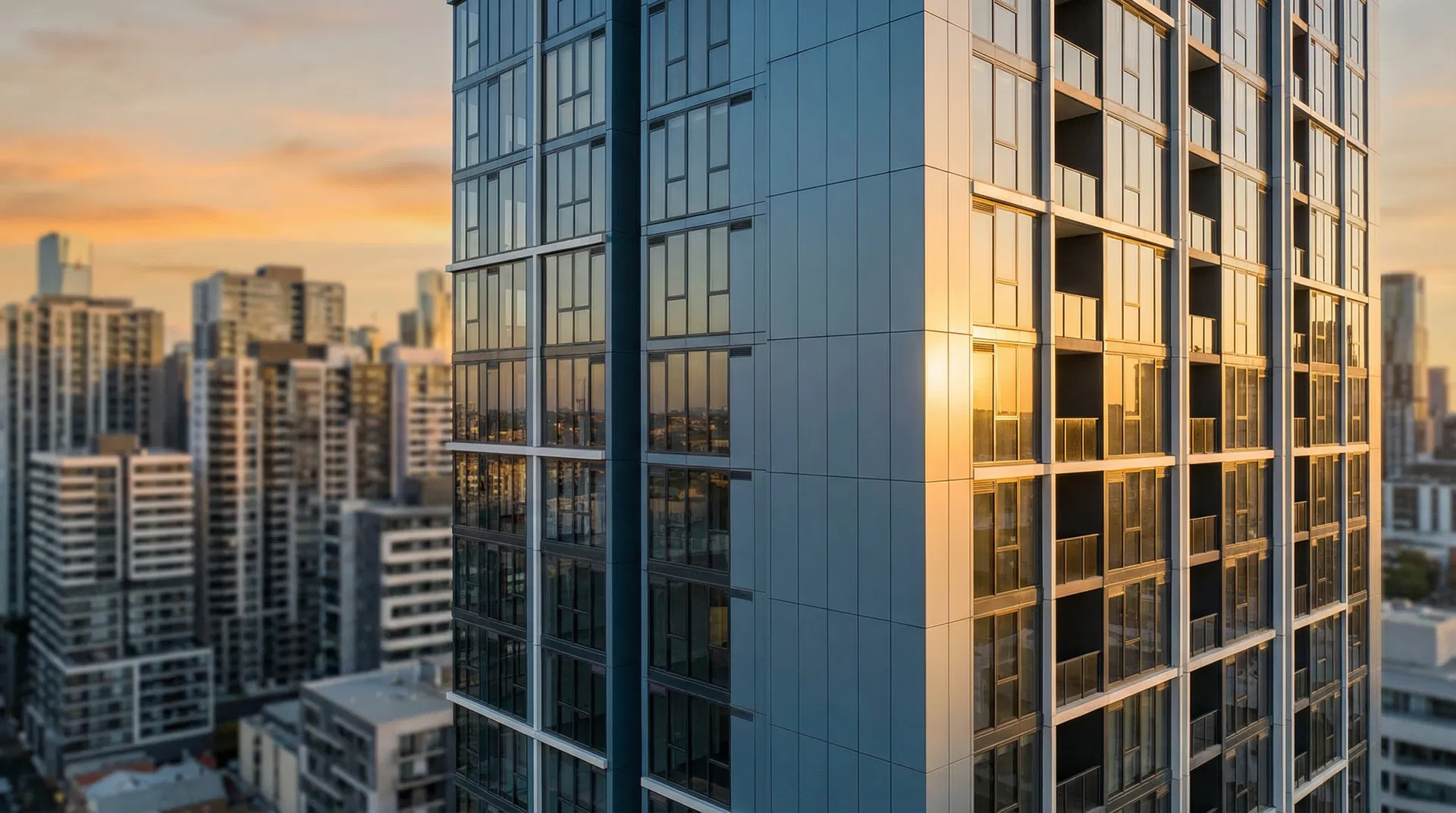
Combustible Cladding & Apartment Purchases in Victoria
Before you buy into a medium or high-rise apartment building, you need to understand the cladding risks, the audit findings, any building notices, and what it will cost you. This guide covers everything.
Important: This guide provides general information only and does not constitute legal or financial advice. Always engage a qualified conveyancer and solicitor before signing a contract of sale.
Overview
Five Things Every Buyer Must Know
Section 01
What Is Combustible Cladding?
Understanding the material, the risk, and why Victoria acted
Cladding is the external skin applied to a building's facade — used for thermal and acoustic insulation, weather resistance, and aesthetics. The problem arose with two specific materials widely used in Australian apartment construction from the 1990s through to the mid-2010s:
Aluminium Composite Panels (ACP)
ACP consists of two thin aluminium sheets bonded to a core material. When the core is polyethylene (PE) — a highly flammable plastic — the panel can ignite and spread fire rapidly up a building's exterior. PE-core ACP was the material involved in the 2014 Lacrosse Tower fire in Melbourne's Docklands and the 2017 Grenfell Tower tragedy in London.
Expanded Polystyrene (EPS)
EPS is a rigid foam insulation material used in external insulation and finish systems (EIFS). While less dramatically flammable than PE-core ACP, EPS can still contribute to fire spread and produce toxic smoke. Its use on buildings above a certain height is now prohibited in Victoria.
In 2018, the Victorian Government banned the use of cladding panels with polyethylene and EPS cores through the Building Amendment (Registration of Building Trades and Other Matters) Act 2018. However, the ban only addressed new construction — the legacy problem of existing buildings already clad with these materials remained, affecting an estimated 1,700+ residential apartment buildings across Victoria.
Which buildings are affected?
The cladding issue primarily affects Class 2 buildings (multi-unit residential — apartments) and Class 3 buildings (accommodation such as serviced apartments and hotels) that are three storeys or more in height, constructed or substantially renovated between approximately 1994 and 2018. Buildings of four storeys or more are at significantly higher risk.
Key Statistics
The Lacrosse Tower Fire — 2014
A cigarette ignited PE-core ACP cladding on Melbourne's Lacrosse Tower in Docklands. Fire spread 13 floors in minutes. No fatalities, but the event triggered Victoria's entire regulatory response. The subsequent legal proceedings confirmed that builders, building surveyors, and fire engineers bore liability.
Section 02
The Statewide Cladding Audit
How the Victorian Building Authority assessed the state's apartment stock
Following the Lacrosse fire and the Grenfell Tower tragedy, the Victorian Building Authority (VBA — now the Building and Plumbing Commission) commenced a statewide audit of all Class 2 and Class 3 buildings three storeys or more in height. The audit commenced in late 2017 and ultimately assessed over 2,200 buildings.
The audit was conducted in stages. Councils were initially directed to identify potentially affected buildings in their municipalities. The VBA then undertook desktop assessments of building permits and plans, followed by physical inspections where warranted. Buildings were assessed against the National Construction Code (NCC) and relevant Australian Standards.
Buildings found to have non-compliant cladding were categorised by risk level. The highest-risk buildings — those where the cladding presented an unacceptable fire risk — were referred to Cladding Safety Victoria (CSV) for funded rectification. Lower-risk buildings were managed through the Cladding Remediation Partnership Program (CRPP) under Minister's Guideline MG-15.
Audit Outcomes — Risk Categories
Referred to CSV for funded rectification. VBA assumes Municipal Building Surveyor (MBS) functions. Building Notice or Order issued. Owners corporation enrolled in CSV program.
Managed through the Cladding Remediation Partnership Program (CRPP). Councils act as MBS. Owners must implement a Remediation Work Proposal (RWP) under MG-15. Owners fund works themselves.
Building has been assessed as compliant, or rectification works have been completed and signed off. Building Notice or Order withdrawn. CSV program closed for that building.
Building was not identified in the audit as having non-compliant cladding, or is below the height threshold. May still have cladding — absence of audit finding does not guarantee no cladding.
What the audit does NOT tell you
The audit identified buildings with non-compliant cladding. A building not appearing on the audit register does not mean it has no cladding — it may simply not have been audited, or may have cladding that was assessed as lower risk. Buyers should independently verify the cladding status of any building they are considering purchasing into, regardless of whether it appears in audit records.
Section 03
Building Notices & Building Orders
Enforcement tools that directly affect the building you are buying into
Under the Building Act 1993 (Vic), the relevant Municipal Building Surveyor (MBS) — either the local council or the VBA for high-risk buildings — has the power to issue enforcement notices and orders requiring owners to take action in relation to non-compliant cladding.
Building Notice
A Building Notice is a preliminary enforcement step. It notifies the owner that the MBS believes the building may have a problem and requires the owner to provide information, engage experts, or take specified steps within a stated timeframe. It does not itself require rectification works, but failure to respond can lead to a Building Order. A Building Notice is a formal legal document that must be disclosed in the Section 32 Vendor Statement.
Building Order
A Building Order is a stronger enforcement instrument. It requires the owner to carry out specific works (including rectification of cladding) by a specified date. Non-compliance with a Building Order is a criminal offence. The MBS may also carry out the works and recover the cost from the owner. A Building Order must be disclosed in the Section 32 Vendor Statement and in the Owners Corporation Certificate.
What an Active Notice Means for Buyers
Mandatory Disclosure
The vendor must disclose any current Building Notice or Building Order in the Section 32 Vendor Statement. Failure to disclose may give the buyer the right to rescind the contract.
Financial Liability
If you purchase a lot in a building with an active Building Order, you inherit the obligation to comply. If the owners corporation has not yet raised a special levy to fund works, you may face a significant levy after settlement.
OC Certificate Disclosure
The Owners Corporation Certificate (required in the Section 32) must disclose any notices or orders affecting the property. Check this document carefully — it must be current at the time of the Section 32 preparation.
Special Levies
Under Victorian law, special levies struck by the OC before the day of sale are the vendor's responsibility. However, levies struck after sale — even for works already planned — fall to the new owner. Timing is critical.
A Notice Withdrawn Is Not the Same as Works Complete
A Building Notice may be withdrawn or superseded without the underlying cladding issue being resolved. Always ask for evidence of the specific outcome — not just that a notice is "no longer active." What you need is documented evidence that works have been completed and signed off by the relevant building surveyor.
Section 04
The Rectification Process
How Cladding Safety Victoria manages works on high-risk buildings
The 10-Step CSV Rectification Process
Building Identified
VBA audit identifies the building as high-risk. VBA assumes MBS functions and issues a Building Notice.
Referred to CSV
VBA or council refers the building to Cladding Safety Victoria for assessment and potential funding.
CSV Assessment
CSV assesses the building's eligibility for funding based on risk level, building type, and readiness.
Funding Agreement
CSV invites the Owners Corporation to enter a Funding Agreement. CSV assigns a project manager to the building.
Scope of Works
CSV's project manager works with the OC and specialists to develop a detailed scope of rectification works.
Tender Process
CSV oversees a competitive tender process to engage a qualified contractor for the rectification works.
Building Permit
A building permit is obtained for the rectification works from the relevant building surveyor.
Works Undertaken
Rectification works are carried out under CSV's supervision. The OC and residents are kept informed.
Inspection & Sign-Off
Works are inspected and a Certificate of Final Inspection (or equivalent) is issued by the building surveyor.
Building Notice Withdrawn
The Building Notice or Order is formally withdrawn. The building is removed from the high-risk register. CSV program closed.
The Cladding Remediation Partnership Program (CRPP)
Not all buildings with combustible cladding qualify for full CSV funding. Buildings assessed as presenting a lower risk are managed through the CRPP, introduced in 2023 under Minister's Guideline MG-15.
Under the CRPP, councils act as MBS and work with CSV to develop a Remediation Work Proposal (RWP) for each building. The RWP is a risk-based assessment that may not require full cladding removal — it may instead prescribe fire safety upgrades, sprinkler systems, or partial cladding replacement to reduce risk to an acceptable level.
Critical for Buyers
For CRPP buildings, owners fund the works themselves. There is no CSV grant. The OC must raise the funds through special levies, OC loans, or Cladding Rectification Agreements (CRAs). The cost per lot can be substantial.
What "Rectification Complete" Means
When works are complete, buyers should expect to see a bundle of documents — not a single "cladding certificate." Evidence of completion typically includes:
- Certificate of Final Inspection from the building surveyor
- Building Notice or Order formally withdrawn in writing
- Contractor completion documentation and warranties
- Updated building insurance confirming cladding risk resolved
- CSV program closure letter (for CSV-funded buildings)
Insurance Impact During Rectification
Buildings with active cladding issues often face significantly higher insurance premiums, higher excess amounts, or limited coverage. Some insurers may decline to cover the building entirely. This affects the OC budget and, by extension, your levies. Once rectification is complete, CSV has worked with insurers to ensure premiums return to normal levels.
Section 05
Who Pays for Rectification?
State grants, owner-funded loans, and what you inherit as a buyer
High-Risk Buildings — State-Funded Grant
For buildings enrolled in the CSV program and assessed as unacceptable risk, the Victorian Government provides a grant — not a loan — to fund the rectification works. The OC does not repay this money directly.
As of June 2024, CSV had paid approximately $341 million in grant payments to 387 Owners Corporations.
State Subrogation Rights
The State retains the right to pursue builders, developers, and others responsible for the non-compliant cladding to recover the grant funds. A landmark 2025 Court of Appeal decision confirmed the State can be subrogated to the rights of both the OC and individual lot owners. This does not affect the OC's or buyer's obligations — but it means the State may pursue legal action in the OC's name.
Lower-Risk Buildings — Owners Pay
Buildings in the CRPP category do not receive CSV grants. The OC must fund the works itself. Common funding mechanisms include:
- •Special levy raised by the OC (can be tens of thousands per lot)
- •OC loan from a financial institution
- •Cladding Rectification Agreement (CRA) — see below
- •Refinancing of existing mortgages by individual owners
Buyer Risk
If you buy into a building where works have not yet been funded, you may face a significant special levy shortly after settlement. Always ask whether a special levy has been struck, proposed, or foreshadowed.
Cladding Rectification Agreements (CRAs)
A CRA is a three-way voluntary agreement between an owner or OC, a lender, and a council. The lender loans funds to the owner/OC for rectification works, and repayments are collected through the council rates system.
This is a loan that must be repaid. Repayments are attached to the property via the rates system, which means they run with the land — not the individual owner. If you purchase a property subject to a CRA, you take on the outstanding repayment obligations.
Due Diligence Required
Always check with the council whether a CRA is registered against the property. This should appear in the council rates search, but ask specifically — do not rely solely on the Section 32.
Frequently Asked Questions — Funding
Section 05b
Can You Search a Building by Address?
The honest answer: there is no single public register searchable by address — but there are several targeted ways to find out
No Comprehensive Public Address Register Exists
Despite repeated calls from consumer advocates, the Victorian Government has not published a comprehensive, publicly searchable register of all cladding-affected buildings by address. The Government's position has been that such a list would be rapidly out of date, could stigmatise buildings unfairly, and could affect property values and insurance before rectification is complete. The CSV "Project Completion — Council by Council" dashboard shows aggregate statistics by council area, not individual building addresses.
What You Can Check — and How
1. CSV Project Completion Dashboard
Available OnlineCSV publishes a Power BI dashboard at vic.gov.au/project-completion-council-by-council that shows the number of buildings in each council area that are: in the program, works complete, or works in progress. It does not list individual building addresses, but it tells you how many buildings in a given council area are still active — useful context for a suburb-level risk assessment.
View CSV Dashboard2. Contact the BPC (formerly VBA) Directly
By RequestThe Building and Plumbing Commission (BPC) holds the audit records for all buildings assessed in the statewide audit. You can contact the BPC and request the audit report for a specific building. The BPC may ask you to provide:
- ›Photo identification (e.g. driver's licence)
- ›Confirmation that you are a prospective purchaser of a lot in the building
- ›The building address
This process is not instant — allow several business days. It is not a formal FOI request (no fee), but the BPC has discretion over what it releases. The report, if provided, will confirm whether the building was audited and what the outcome was.
Contact the BPC3. Contact the Local Council
By RequestFor buildings managed under the CRPP (lower-risk category), the relevant local council acts as the Municipal Building Surveyor. The council holds records of any Building Notices or Building Orders issued against the property. You can:
- ›Request a building information certificate or building file search from the council
- ›Ask specifically whether a Building Notice or Building Order has been issued for the property address
- ›Ask whether a Cladding Rectification Agreement (CRA) is registered against the property
- ›Request a copy of any Remediation Work Proposal (RWP) lodged for the building
Council building file searches typically cost $50–$150 and take 5–10 business days. Your conveyancer can arrange this as part of standard pre-purchase searches.
4. FOI Request to CSV
Formal ProcessIf a building is in the CSV program, CSV holds detailed records including facade inspection reports, fire engineering reports, building permits for rectification works, and Remediation Work Proposals. These can be requested:
Without a formal FOI application
Building owners (and in some cases prospective purchasers) can request building permits, occupancy permits, fire engineering reports, facade inspection reports, and RWPs directly from CSV by emailing [email protected]. CSV will verify your entitlement to receive the documents.
Via a formal FOI application
Any person can lodge a formal FOI request with CSV. There is an application fee (currently $32.70 for standard requests). CSV has 30 days to respond. This is the most powerful tool for obtaining comprehensive records about a specific building.
5. Section 32 & OC Certificate — The Most Reliable Source
Most ImportantFor buyers, the most reliable and legally significant source of building-specific cladding information is the Section 32 Vendor Statement and the Owners Corporation Certificate. These documents:
- Must disclose any current Building Notice or Building Order
- Must disclose any special levies struck or approved by the OC
- Must disclose any pending legal proceedings
- Must include current insurance details
- Do NOT automatically disclose a building that was audited but found compliant
- Do NOT disclose notices that were issued and withdrawn before the certificate date
The gap: A building that was audited, issued a notice, and then had works completed and the notice withdrawn will show no current notice in the Section 32 — but the history of the cladding issue will not automatically appear. This is why you must also request the OC minutes and the cladding pack.
Quick Reference — How to Check
Why the Absence of a Notice Is Not Enough
A building that does not appear in any public record, has no current Building Notice, and has no mention in the OC Certificate may still have combustible cladding — it may simply not have been audited, or may have been assessed as lower risk without formal enforcement action. The absence of a public record is not confirmation that a building is cladding-free. The only way to confirm the cladding status of a specific building is to obtain the building's audit report from the BPC, review the OC's historical records, and if necessary engage a qualified building consultant to inspect the facade.
Section 06
Buyer Due Diligence
A structured approach to investigating cladding risk before you sign
Step 1 — Before You Make an Offer
Visual Inspection
Look at the building exterior. Does it have a flat, panel-based facade? Knock gently on the exterior wall — a hollow sound may indicate lightweight cladding rather than solid masonry. Buildings over four storeys constructed between 1994 and 2018 are the highest-risk cohort.
Ask the Agent Directly
Ask the selling agent: "Has this building been identified in the VBA statewide cladding audit? Are there any current Building Notices or Orders? Has any rectification been undertaken or is it planned?" Get answers in writing.
Check the CSV Project Completion Register
Cladding Safety Victoria publishes a council-by-council project completion register on its website. Check whether the building appears and what its status is.
Step 2 — Review the Section 32 Vendor Statement
Building Notices and Orders
The Section 32 must disclose any current Building Notices or Building Orders affecting the property. If none are disclosed, ask your conveyancer to confirm this with the council directly.
Owners Corporation Certificate
The OC Certificate must be current and must disclose: current fees, any special levies struck or approved, insurance details, notices or orders, and any pending legal proceedings. Read it carefully — do not rely on a summary.
Timing of the OC Certificate
An OC Certificate is only valid at the time of issue. If it is more than a few weeks old, request an updated certificate. A new levy or notice issued after the certificate date will not appear.
Step 3 — Request the "Cladding Pack"
Beyond the Section 32, request the following documents from the vendor or OC manager:
OC minutes for the last 24 months (look for any mention of cladding, facade, fire safety, major works, or insurance changes)
OC financials and budget — check for reserves allocated to cladding works
Levy schedule — including any special levies raised, proposed, or foreshadowed
Any Building Notices or Orders and their current status
Any building consultant, fire engineer, or cladding assessment reports
If works are complete: Certificate of Final Inspection, Building Notice withdrawal letter, and CSV closure documentation
Current building insurance certificate of currency — check for cladding exclusions or elevated excess
Step 4 — Engage Your Professional Team
Conveyancer / Solicitor
- ›Review Section 32 for completeness and accuracy
- ›Confirm disclosure of all notices and orders
- ›Advise on special levy timing and liability
- ›Conduct council rates search for CRAs
- ›Negotiate contract conditions if cladding issues exist
Mortgage Broker / Lender
- ›Disclose cladding status to lender early
- ›Some lenders require additional evidence before approving finance
- ›LMI (Lender's Mortgage Insurance) may be declined for buildings with active notices
- ›Valuer may flag cladding issues — provide documentation proactively
Building Inspector (Optional but Recommended)
- ›Commission a pre-purchase building inspection
- ›Ask inspector to specifically comment on cladding type and any visible concerns
- ›For high-value purchases, consider engaging a specialist facade consultant
Finance & Valuation Considerations
Lender Requirements
Some lenders require evidence that cladding issues have been resolved before approving finance. Others may approve finance but require a higher deposit or decline LMI. Disclose cladding status to your broker early — do not wait until valuation.
Valuation Impact
The Australian Property Institute (API) has issued a Valuation Protocol for cladding on buildings (effective 1 January 2025). Valuers are required to identify and report cladding issues. An unresolved cladding issue may result in a lower valuation or a qualified valuation report.
Resale Value
Buildings with unresolved cladding issues can be harder to sell and may achieve lower prices. Once rectification is complete and documented, this stigma typically dissipates. Consider the long-term resale implications if works are still in progress.
Section 07
Buyer Due Diligence Checklist
Use this interactive checklist when investigating a Victorian apartment purchase
Tick items as you complete them. Priority levels: HIGH = must do before signing, MEDIUM = important, LOW = recommended
Before Making an Offer
Section 32 Review
The Cladding Pack — Request These Documents
Professional & Financial Checks
Section 08
Key Resources & Official Links
Official Victorian Government and regulatory sources for further information
Cladding Safety Victoria (CSV)
The state body responsible for managing the $600M rectification program. Check project completion status by council.
Building & Plumbing Commission (BPC)
Formerly the VBA. Responsible for the statewide audit and MBS functions for high-risk buildings.
Consumer Affairs Victoria — Due Diligence Checklist
The mandatory due diligence checklist that all sellers and agents must make available to buyers.
Cladding Rectification Funding Guidelines
Victorian Government guidelines on how CSV funding agreements work and eligibility criteria.
Cladding Remediation Partnership Program
Information on the lower-risk building program under Minister's Guideline MG-15.
Buying or Selling with Combustible Cladding
Victorian Government guidance specifically for buyers and sellers of apartments with cladding issues.
Important Disclaimer
This guide provides general information about Victoria's combustible cladding regime as at early 2026. It is intended to assist buyers and their advisers in understanding the key issues and undertaking appropriate due diligence. It does not constitute legal, financial, or building advice.
The cladding regulatory landscape continues to evolve. Legislation, guidelines, and program parameters may change. Always verify current requirements with the relevant authorities and obtain independent professional advice before making any property purchasing decision.
Key legislation referenced: Building Act 1993 (Vic), Cladding Safety Victoria Act 2020 (Vic), Sale of Land Act 1962 (Vic), Owners Corporations Act 2006 (Vic), Building Amendment (Registration of Building Trades and Other Matters) Act 2018 (Vic).